Argonne National Laboratory
Nuclear Engineering Division
Think, explore, discover, innovate
Nuclear Engineering is a Division of Argonne National Laboratory (Argonne), a U.S. Department of Energy laboratory managed by UChicago Argonne, LLC

Home > Activities > Major Capabilities > Nuclear Systems Modeling and Design Analysis > Nuclear Fuel Cycle and Waste Management Technologies

Nuclear Fuel Cycle and Waste Management Technologies

Overview

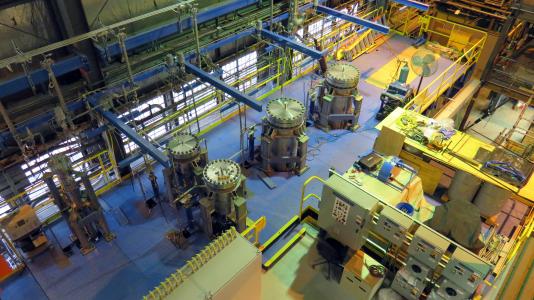
Much of the NE Division's research is directed toward developing software and performing analyses, system engineering design, and experiments to support the demonstration and optimization of the electrometallurgical process for treating spent nuclear fuel. This treatment technology is being demonstrated at the former Argonne facilities in Idaho by using fuel assemblies previously irradiated in the EBR-II reactor. The objective of the treatment is to transform sodium-bonded metallic fuel from EBR-II (classified as mixed waste) into a uranium product, for return to the nation's enriched uranium inventory, and two types of waste forms (metal and ceramic) containing the radioactive fission and activation products. These waste forms have been developed to stabilize the high-level waste from the treatment as compact monoliths that are suitable for disposal in a geologic repository.

The NE Division has capabilities to both develop and use process modeling, design, and analysis software to address a wide variety of nuclear fuel cycle and waste management issues. Software development has included the use of multiple operating system environments, high level programming languages, Internet-based client-server applications, and large-scale database development. These capabilities have been used to support projects in facility operations, nuclear material control and accountability, criticality safety, process evaluation, and nuclear waste qualification.

Software development is part of the general engineering and scientific modeling capabilities of the division. Detailed phenomenological and empirical models are developed and used to support projects in nuclear waste degradation, geologic repository performance, and nuclear fuel processing.

The NE Division also has significant capability in the use of specialized commercial engineering software, including computational fluid dynamics (CFD) codes such as Star-CD, Fluent, and FIDAP, heat transfer codes like SINDA, network flow systems analysis codes like FlowMaster, general system dynamics codes such as GoldSim, VectorFields software for electromagnetic design, other commercial products such as the Oracle database system, and various public domain tools. These tools have been used for detailed analysis projects related to nuclear fuel processing and nuclear waste management.

The NE software development and analysis activities involve modeling the treatment process unit operations and characterizing material inventories and mass flows for the various process steps, including waste form production and packaging operations and performing safety, hazard, and risk evaluation. Division staff are also developing models for predicting the performance of the waste forms in a geologic repository. The modeling is conducted on the basis of theoretical considerations and the experimental results of waste form testing and qualification efforts performed in Argonne's Chemical Technology (CMT) Division. The Nuclear Engineering Division also has expertise in the area of systems and components development as applied to Fuel Cycle and Waste Management Technologies.

Contact:
Nuclear System Analysis Department
Dept. Manager: Robert N. Hill
Fax:  +1 630-252-4500


ARGONNE NATIONAL LABORATORY, Nuclear Engineering Division
9700 South Cass Ave., Argonne, IL 60439-4814
A U.S. Department of Energy laboratory managed by UChicago Argonne, LLC
 

Last modified on July 05, 2007 17:11 +0200